How can you not love a film with this much mindless violence and a cool alien?
One of my favorite films from the 80's (I've long since lost count of the number of times I've seen it) The Hidden is a science fiction roller-coaster ride starring Kyle MacLachlan and Michael Nouri (and featuring Claudia Christian as a stripper who actually screws someone to death!).
While the original idea of a criminal alien parasite being hunted by another member of it's species dates back at least to Hal Clement's first novel, Needle, The Hidden ramps it up to overdrive. Where Needle largely involves detective work, The Hidden mostly involves crazy car chases, lots of guns, and much in the way of general mayhem.
But it's not just the mayhem which makes this worth watching. Kyle MacLachlan's portrayal of the FBI agent (yes, again!) is particularly entertaining, the dialogue is clever, and, of course, the basic concept is pretty damn cool.
I can't recommend this one enough. While a little dated, it's worth watching for the first 10 minutes alone.
Tuesday, January 8, 2013
Sunday, December 2, 2012
Why So Long?
Well... It's been a LONG time between entries; I've been ridiculously busy for the last year - I started work (at a real job), and it's been keeping me so busy I just haven't found time to watch half as much as I used to, let alone comment on what I have watched. It's time that changed!
So, within a day or two, I'll start posting regularly (at least once a week). I've got a lot of new movies to share - I like to focus on the less well-known, a lot of the time, as these are the ones which most excite me (it's always nice to find a diamond amongst the coal!).
So bear with me, and I'll be back in a couple of days.
Monday, April 25, 2011
Logan's Run (1976)
I remember seeing this one at the movies, back when I was obviously too young to know any better...
One thing I do remember is that you got to see Jenny Agutter's tits, which impressed 13 year old me no end. Of course, for a while there, you got to see them in any movie she was in, which was certainly no hardship! She was, and still is, a very attractive woman, as well as being a more-than-capable actor.
Michael York, who plays Logan, was always one of those actors whose appeal eluded me - He reminds me a lot of Charlton Heston; they seemed to get the lead roles in a lot of the films I ended up watching, but neither of 'em ever bother to act, or if they are, they only know one "character". I find them both irritating to watch, but not irritating enough to spoil a film; in fact, I often find myself laughing at them (in all the wrong spots) more than anything else!
The director, Michael Anderson has some good films in his resumé (he directed The Dam Busters, one of my all time faves). This just isn't one of them.
Faults? Where to start... Let's start with the city. I know we're a little spoilt these days; CGI cityscapes can look amazingly realistic (but they don't always - This is one place where cheap CGI work can really show). The city in Logan's Run never, ever, looks like anything other than what it is; a large model. The most obvious detail is the trees; they are so obviously from a model train supply house. The lack of detail on the buildings also doesn't help with the illusion - Everything looks small; given the low quality of the model-making, you'd think they'd minimise your exposure, but they actually seem to go out of their way to show the outsides of the buildings. Oh well, it was 1976...
The "Carousel" sequence has also aged badly - While there was only one point where I could actually see the wires (there may be more), it was still very obvious that the people were on wires, if only due to the limited range of movement available to them. The force-field effect probably helps to hide the wires, just not well enough. Not as bad as the wires in The Black Hole, though, which is something, at least.
There are several points during their encounter with Box (the robot) where you can see the face within the silver mask, which is less excusable than some of the other technical mistakes; this is the sort of thing which could be easily fixed, even with 1970's SFX technology, if only by reshooting those scenes... And don't even get me started on the terrible super-imposition of the ice-cave collapsing around them. AWFUL!
One thing I noticed, more than anything else, was the pace. It really did feel incredibly slow at many points. What makes this most interesting is in comparison to the original book; William F Nolan's novel is probably the quickest read I've ever found - I can finish it in a couple of hours, easily. The film seemed to take MUCH longer! I can only hope that the upcoming remake sticks a little closer to the book, and doesn't just try to copy the movie version.
The one saving grace of the film (apart from the aforementioned Jenny Agutter's lovely anatomy) is Peter Ustinov, who is pretty much the antithesis of York or Heston; any film he's in, I know I'm at least gonna find him enjoyable. Not enough to save a really bad film, but certainly enough to make it a little bit more tolerable... He gets a strange mixture of really, really good lines, and some truly God-awful ones in this film.
So much for my blast-from-the-past. It's funny how often a film you really enjoyed as a child/teenager turns out to be virtually unwatchable 35 years later... Some of it is the effects, but I often find that a good enough film can transcend this. There are many films from more than 70 years ago that still hold up extremely well, even though there effects are quite laughable - The most important part of ANY film is story. And that's were Logan's Run fails; they took some of the great central ideas from the novel, and ignored what made it good, somehow. I honestly don't know how they managed it. I do know, however, that next time I think of watching it, I'm gonna try to remember to read the book instead. Far more entertaining. And quicker.
Sunday, April 17, 2011
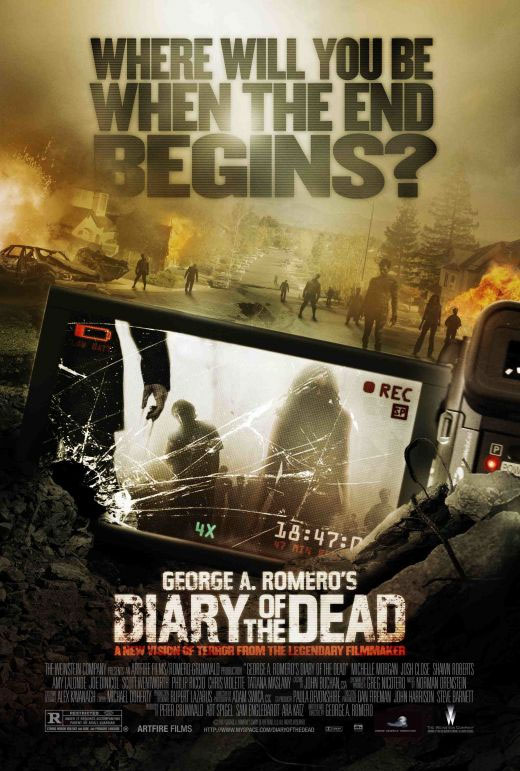
Diary of the Dead (2007)
George Romero proves he's still the undisputed master of zombie films...
I've never seen a Romero film I didn't like. The man is brilliant; often hampered by a ridiculously low budget and a cast of complete unknowns (or actual non-actors) actors, his ideas & execution always manage to transcend these limitations. Taking the idea of "found footage", he re-boots his vision of the zombie apocalypse, only this time in the form of a video documentary, filmed by a group of survivors.
Diary of the Dead starts with the filming of a student project, with a particularly amusing reference to the current "fast zombie" trend; this had me cracking up - I had to pause the DVD & replay it, just to hear the rest of the dialogue! The filming is interrupted by the news of strange goings on... And everyone scatters to try to find out what's going on, and to seek safety in familiar environments.
We end up with a sort of "found footage road movie", more than anything else; as the main characters proceed across country to reach a variety of "safe" destinations, they encounter a fair sampling of the kinds of unpleasantness you could expect when law and order break down. These are, of course, extremely well-handled by Romero, and have that feeling of gritty realism that is a hallmark of his films.
One of the most interesting inclusions is the (sparing) use of CGI to add to the usual makeup effects; as noted by Rick Baker when making An American Werewolf in London, you can add makeup to a person, but you can't take stuff away (he had no option but to use a puppet for the final encounter with the decomposing Jack in the theatre scene), and this is where CGI has a distinct advantage. There are several scenes where CGI is used to great effect in this regards; one involves a zombie's head partially dissolving, and the other... Well, let's just say it's quite disturbing, and you really can't miss it! Of course, like all of the best well-executed CGI effects, I may be wrong; maybe it isn't...
Anyway, if you're a Romero fan, or if you like your zombie movies, this is an absolute must-see. I won't say it's better than it's predecessors, but it's certainly on a par. Given that this is his 5th "Living Dead" film, that's saying something.
Friday, January 28, 2011
Outlander (2008)
They spent $50 million on this film, and then, apparently, just hung it out to dry. The distributors certainly didn't seem to do anything much to try and get their money back. With a total, worldwide, gross of just under $7 million, they'd better hope that it sells a lot on DVD/Blu-Ray. Oh, no, hang-on. I've never heard of it. And, neither, apparently, has anyone else...
Why is it that some films, for whatever reason, just disappear into the crowd? I've heard that it costs about as much to distribute and advertise as it does to make a movie; while not strictly true, the real blockbusters certainly have millions spent on their advertising budget. Long before Avatar came out, there wasn't a single person in the western world who didn't know it was coming. So, if you have confidence in your product (or, maybe, if you just think you can bluff your way to at least some initial returns on your investment), you have to spend some money and effort getting it into the public consciousness. If you have no confidence, you can always let it sit on a shelf for a year or two while you try to work out what to do. What you shouldn't do, however, is just release it to a couple of theatres, and then forget all about it.
The most surprising thing, when confronted with a film that you've never even heard of, is when it turns out to be, not just good, but bloody great fun. We're not talking Gone With The Wind, here people; it'll never make anyone's top 10 list. But it sure as hell at least deserved a chance to make its money back. When Amazon suggested I buy Outlander, I figured "Well, the DVD's got a spaceship on the cover - I might just check it out and see if it's any good".
The basic plot is pretty simple - An "alien" (played by James Caviezel, from the excellent remake of The Prisoner) crashes into a lake in Norway, around about 700 AD, and ends up being taken prisoner by some of the locals. When it turns out that one of his enemies stowed away on his spaceship, and is now killing the locals, they all join together to fight back.
I use the term alien loosely, as humans are, supposedly, descended from an earlier, abandoned, alien colony. Seems improbable, but, what the hell, it's as good an excuse as any for allowing the main character to be both a technologically advanced alien and a human at the same time. In reality, this is probably the only completely implausible element in the story, harkening back to an earlier age of science fiction, when we had less of an understanding of evolution and genetics.
At any rate, the cast is good (including John Hurt and Ron Perlman), the script is reasonable, and the action sequences are well put together. The effects are above average, and the depiction of the Norse way of life had the feeling of authenticity to it. All-in-all, I just can't understand why the studio didn't realise that they had a winner on their hands. People that stupid deserve to lose money!
Still, the other people involved don't, so, do them a favour and, if you like a bit of science fiction with your viking action, at least rent the film. Personally, I'm going to take Amazon's advice and buy it. I liked it that much. In fact, I'd have to say that it's the best viking science fiction film I've ever seen, and their should be more of 'em (more than one, at least!).
Monday, November 22, 2010
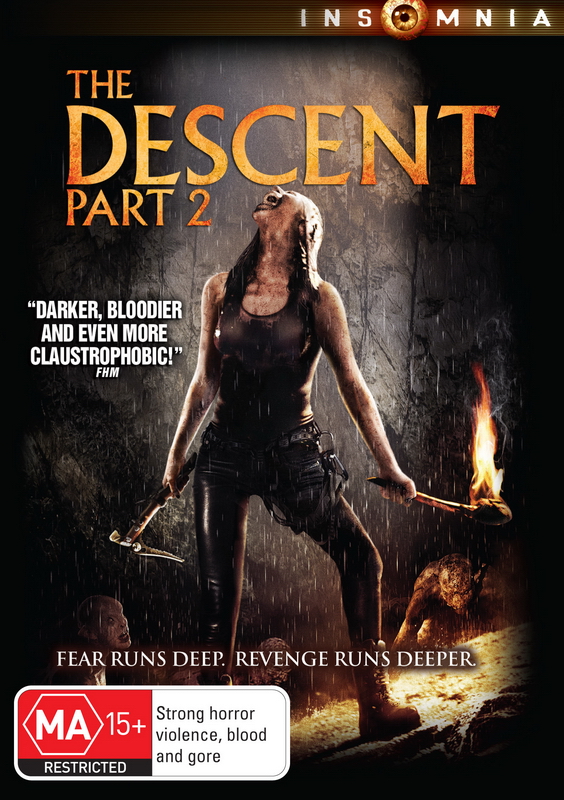
The Descent, Part 2 (2009)
Aah, sequels... They're mostly shit, but, every now and again, you come across a really good one, as good as, or (extremely rarely), even better than the original film. Unfortunately, The Descent, Part 2 definitely falls into the first category.
I really enjoyed The Descent. Like all of Neil Marshall's films, it is excessively gory, ultra-violent, and action-packed. Also, like his other films, its execution creates an atmosphere where it is incredibly easy to suspend disbelief. It tells the story of a group of female thrill-seekers who decide to go pot-holing in the Appalachians, only to discover a group of inbred, carnivorous mutant cave-people sharing the cave with them. For anyone who hasn't seen the first film, you should probably stop reading now!
One of the better aspects of the first film is its depiction of tough, self-reliant women. They are well-prepared (although not well enough - It's hard to prepare for inbred mutant cannibals when noone told you to expect them), and more than capable of taking on any ordinary challenge. Anyway, by the end of The Descent, there is one survivor from the group, who manages to find a way out of the caves.
We join her at the beginning of Part 2 in hospital, where the police would like very much to know what happened to all her companions. They then drag her back down (ignoring her warnings, which are not helped by her partial amnesia) into the caves to help them locate the rest of her friends.
The majority of the film is quite well done; it has action, gore, and tension, and is really well constructed. Where it completely falls apart is at the end. Another major spoiler warning here, as I'm just about to do an "end of film" spoiler; the worst kind of spoiler there is.
Okay, still here? Good... Now, I'm a big fan of films where everybody dies. When I look at my DVD rack, pretty much every second film falls into this category. However, all of them have one thing in common - It is completely logical, and not unexpected, that everyone will die. They quite obviously had no chance, and this was obvious from fairly early on, either because we know more than they do about what they're facing, or, sometimes, because the odds they face are simply overwhelming. Nevertheless, we enjoy the film, and root for the heroes, even on second viewings, and even when we don't believe that they have a snowflake's chance in hell of getting out of the mess they've found themselves in.
Other films, however, are set up differently. Many, many films require the hero (and maybe some others) to survive in order to preserve the narrative and satisfy the audience. We root for them, they pull through against ridiculous odds, and we cheer at the end when they stand up, often drenched in blood, and roar their challenge at fate and the Gods. The Descent gave us this satisfaction, as did Halloween, Die Hard, and many others.
The Descent, Part 2 has a great climactic scene, where the survivor of the first film sacrifices herself so that the hero of the second film can escape from the caves. It is unfortunate that, as the hero is running through the trees to her freedom, she is inexplicably hit in the head with a shovel by this guy we met at the beginning of the film, and dragged back to the cave mouth to be eaten. There is no explanation for this. It just happens out of the blue, and for no apparent reason. The guy seemed genuinely scared at the beginning of the film, before they went down, and had no apparent motive, nor any obvious connection to the subterranean mutants.
And that feeling you get, when the hero has survived against incredible odds? After another character has heroically sacrificed themselves so that the hero can live? Dashed. Destroyed. Irrevocably wiped. Defeat snatched from the jaws of victory.
Completely unsatisfying, and a total let-down after such good story-telling up until that point.
The Awakening (1980)
I noticed The Awakening in the TV guide a couple of weeks ago, in the middle of the night, on one of the new digital channels (in Australia), and thought it sounded interesting. Charlton Heston, Susannah York, and based on a Bram Stoker novel. What could possibly go wrong?
As it turns out, just about everything. This has to be one of the least scary "horror" movies ever. I don't know whose fault it was; Mike Newell certainly went on to better things (he's still making movies, and big-budget ones at that), and at least half the leads had names and reputations that (you'd think) they'd want to protect.
Heston is one of my least favourite actors; he was hammy, thought he was wonderful, and had no sense of humour. It's unfortunate that he was cast in so many of the best films of their time (Planet of the Apes, Soylent Green, The Omega Man, come immediately to mind, each of which is amongst my favourites). While he detracts from good films, if The Awakening is any indication, he is quite capable of completely destroying an already bad film. He was practically the Nicolas Cage of his time; seemingly cast in every second film made, and always to the detriment of the production.
Of course, while Cage is the acting equivalent of Uwe Boll (i.e. an absolute guarantee that I'm gonna hate the movie), Heston was at least capable enough that you can look past his faults and appreciate the rest of the film. If there's anything to appreciate, of course...
The basic plot is simple enough; obsessed archeologist discovers the lost tomb of some un-named Egyptian princess, ignores all the dire warnings of what will occur if he enters the tomb, and dooms his unborn baby to becoming the vessel for the long-dead princesses return to earth. Nothing we haven't seen before, of course, only not as well done.
Anyway, the first 30 minutes or so are set 18 years in the past - And, in case you forget, or were late getting to your seat in the cinema, they'll remind you fairly early on when we get back to the "present". Heston's long-suffering, pregnant, wife (Jill Townsend in pretty much her last role), gives birth just as he's violating the tomb, but we know, of course, that, even though the baby is born dead, she'll be fine in a minute or two, just as soon as Heston releases the evil princesses spirit. Which, of course, he does. The baby starts crying, and he finally takes the time to go see his wife in the hospital. Too little, too late, so she leaves him, and takes little Maggie with her.
Heston isn't overly bothered, though - he goes onto an illustrious career as a university professor and marries his smart, practical, and attractive assistant, Susannah York. Oh, and anyone trying to interfere with his plans for the princess' mummy is conveniently killed in an "accident". These accidents, which occur off and on throughout the film, make it clear that this was a deliberate Omen rip-off. Only, as silly as The Omen was, it was at least fun and well-made.
Anyway, the rest of the plot will be obvious to anyone watching the film, and proceeds in a pedestrian manner to the Omen-like ending, so I won't talk any more about it. It's all been done before, only better.
What stood out, more than anything else, was the lack of build-up in the script. As an example, Susannah York goes from being supportive, sensible, practical, and scientific, to superstitious, fearful, and stupid instantly. No gradual realisation of the horror to come, just a light-switch change in personality. And the same goes for every other "scare" in the film - There is no gradual increase in tension at any point. Either you already know exactly what's going to happen next, because it's inevitable, or you are suddenly confronted with a complete change in a character.
The only shining light in the entire mess was Stephanie Zimbalist's performance as the doomed daughter of Townsend and Heston. She even won an obscure award for "Best Supporting Actress" for the role, and she really does the best she can with such appalling material.
At any rate, it does serve as a nice counterpoint to The Omen, if nothing else. While both films have very similar plots, the execution of each couldn't be more different. I'd recommend The Awakening to anyone who wants to watch how not to make a film. Garbage! I want my two hours back, please.
Monday, November 8, 2010
Big, Bigger, Biggest
A little while back I decided to have a "giant people from the 50's day"...
I started with Attack of the 50 Foot Woman (1958) proceeded to The Amazing Colossal Man (1957), and wound it all up with War of the Colossal Beast (1958). Let me say that, apart from sheer amusement value, none of these films is actually worth watching. They are all unrelentingly stupid - I guess I'm just a glutton for punishment.
So, let's start with the one with, at least, the best title. Attack of the 50 Foot Woman evokes everything that is best about 1950's B-grade movies. What it doesn't warn you about is that there isn't a single character in the movie who's even the least bit likeable. Nancy Archer (the titular character, played by Allison Hayes) is a spoilt (and stupid) rich woman with a philandering husband, who is obviously only after her money. She runs into an gigantic alien on the way home, with the result that she grows really, really big overnight.
Apart from the blatant misogyny of the script, the biggest fault with this film is the fact that, quite often, you you can see right through Nancy as she strides across the landscape, and the giant alien is also transparent a lot of the time. Now, giant people are one thing, but giant transparent people seems just a bit stupid! At any rate, I can only recommend this film to all the people out there who, just like me, will just have to watch it because its famous and has a great title!
The Amazing Colossal Man is often considered to be the "Gone With the Wind" of giant people films, and with good reason. It has all the required ingredients (crazy explanation, stupid physics, even stupider physiology), some really good effects (and some equally shoddy ones).
Lt. Col. Glenn Manning (Glenn Langan) gets a little to close to a plutonium bomb explosion, and gets a little burned... Like, 3rd degree burns over just about his entire body. At any rate, he miraculously heals overnight, then begins to grow. And grow. And grow. Where it gets really silly, though, is in the explanation that his heart is, for some reason, not growing as quickly as the rest of his body. Why this should be is both never explained, as well as not making any sense at all, but there you go.
His small heart causes circulatory problems, which results in him having a really bad temper for most of the film, and leaving him really, really stupid at the end of it, when he goes on the obligatory rampage, before being "disposed" of. While the miniatures were excellent, and many of the other effects shots were equally impressive, there were some "transparent" moments as well, which detract from the overall affect.
Which brings us, at last, to War of the Colossal Beast, sequel to The Amazing Colossal Man, and, I think, a better film than either of the others. Lt. Col. Manning has made his way down to Mexico, where he is hijacking food trucks to feed his enormous appetite.
Where this film stands out is the makeup. Manning is left horribly disfigured after his "demise", with half his jaw exposed, and one eye missing. While obviously an "additive" effect (i.e. makeup over the actor's face), it is still very impressive, and quite gory. It holds up extremely well, despite the film's age. The miniatures are also very impressive, even if they don't always match the full-scale vehicles at all times! There were also far fewer "transparency" problems in evidence.
Manning appears to have lost his mind completely in this one, and is basically just a giant monster. He finds his way to California, with a climax at the Griffith Observatory which is a lot of fun. Oh, and his heart attacks don't seem to be a problem any more (he should be long dead, according to the experts in the first film!).
At any rate, of all of these "giant people" films, War of the Colossal Beast is, surprisingly, the standout. It's fun, silly, and has the best SFX. You really should watch The Amazing Colossal Man first, if only so you get the whole story, but it's probably not absolutely necessary (the original distributors certainly didn't think so - they didn't even bill it as a sequel). I know for a fact that, now that I've seen it, I won't be feeling the need to watch Attack of the 50 Foot Woman again any time soon (or ever!).
Sunday, October 31, 2010
The Mist (2007)
Well... What can I say?
I just saw The Mist.
An almost perfect adaptation of my all-time favorite Stephen King story, except it’s 2 minutes too long :-(
Stop reading now, if you don’t want to know any more...
It gets the paranoia right. It gets the hopelessness right. It gets the critters right. Then it tacks on the most depressing ending since 1984.
Apparently Frank Darabont made a deal with the producers that, if they let him keep his miserable ending as written, he’d make it for half as much money. They should’ve paid the full amount.
So, my suggestion? Watch the film till they run out of petrol, then turn it off. That way it’s up in the air, just like the original story.
What’s most amusing is that I normally like “Director’s Cuts” of movies. In this case, I’d really like to see a “Producer’s Cut”!
The ending itself is almost an “anti-Spielberg”... Instead of the standard Spielberg approach of tacking on a pathetically happy ending to an otherwise forlorn and depressing film, Darabont has taken the exact opposite approach. He’s tacked on a ridiculously cynical ending onto a forlorn and depressing film.
It all just makes me pine for more endings like Screamers... i.e. endings that, while incredibly dark and dismal, are totally in context, and stem from what we’ve already seen of the behavior of the characters. The one thing that stood out in the story, and in the film right up until that point, was that, in a hopeless situation, the one thing you can’t afford to give up on is hope.
No matter how impossible the odds, or widespread the catastrophe, if you give up, what’s the point of fighting before you give up? It cheapens and detracts from any previous effort.
It also reminds me of the beginning of Alien 3. Ripley never gives up in Aliens, and saving Newt is her moment of glory. At the start of the next film, however, Newt’s just dead. “Oh, I’m sorry, but that was all a waste of time and effort. You understand, don’t you”. I mean, how pathetic!
Oh well, enough of a rant. See it. Don’t see it. Whatever. The shame of it is that it’s just SO good right up until that point. What the hell was he thinking? Why, oh why, do people think they can “improve” on something that they proclaim to love?
Monday, October 11, 2010
Invasion of the Body Snatchers (1956)
A masterpiece.
No matter how dedicated one is to a genre, or even to film in general, there are always some classics that you just never get around to seeing. You know they're gonna be good (or at least they should be, with all the fuss that's made about them), but, for one reason or another, you just keep missing 'em on TV, or there's always something newer and shinier at the local video shop to attract your attention. Or, more and more often these days, you've seen the remake and it was pretty good, so why bother watching the old black & white version of the same story...
Invasion of the Body Snatchers lived up to its reputation. Taut, tense, and action-packed, modern-day thrillers owe a lot to this film. It's only 80 minutes long, but it's got more action and suspense in it than most films manage to pack into 3 hours. I was literally on the edge of my seat for almost the entire time!
Directed by Don Siegel (who's other films include Escape from Alcatraz and Dirty Harry), and starring Kevin McCarthy as an ordinary GP who, upon returning from a medical conference, finds that an awful lot of people in his home town seem to have developed an identical paranoid delusion... Their relatives are not their relatives. They look like them, sound like them, and even remember things that only they could possibly know, but they are not who they appear to be. He investigates, and, slowly but surely, the evidence starts to accumulate, until even the "rational" Dr Bennell can't help but admit that something terrible is going on.
This has to be McCarthy's best role. His character is the absolutely archetypal small-town doctor. He's friendly, debonair, sophisticated, and caring. He's divorced, because his patients always came first. He's witty, charming, and handsome. Of course, by the end of the film, he looks like he's just escaped from a psych ward, but that's the beauty of it.
Of course, by this time he also hasn't slept for about 48 hours, not to mention the horrors he's just been through!
Dr Bennell's love interest in the film, Becky Driscoll (Dana Wynter) also goes from total glam (the dress she wears in her first scene is just gorgeous) to dishevelled wreck during the course of the film. This, of course, is something that we don't see very often, especially in films from this period - Normally, no matter what the heroine's suffered through, the worst that will happen is that she might have a little mud on her dress, and, perhaps, a misplaced hair or two!
As impressed as I was by Kevin McCarthy's performance and character, the cast highlight for me was the always exquisite Carolyn Jones. Her big eyes and delicate features (not as accentuated as they were in The Addam's Family, of course) always portray an extreme level of vulnerability, especially when she plays the role of "the woman who screams at the scary thing".
While described as metaphor for either the imagined communist threat of the 50's, or, equally, as a metaphor for the all-too-real threat of McCarthyism, none of that matters while you're watching it. As you're propelled from one chase scene to the next, and introduced to the exact nature of the threat one step at a time, you are simply buffeted along by the whirlwind. The last thing you care about is the politics; all you care about is whether the hero and his girl are gonna escape...
Yes, it's a bit dated. Some of the romantic scenes are a little flowery and over-the-top by today's standards, and the patriarchy of the 50's is, well, conspicuous (Becky is just a little bit too hopeless when she starts to get tired!). Nevertheless, this is a genuine masterpiece, and one that anyone who wants to make a taut, suspenseful action thriller could learn a lot from.
Saturday, September 18, 2010
4D Man (1959)
You know how you remember seeing a film in your childhood which you really enjoyed, and then when you see it again, many years later, it really sucks? Happens to me a lot, I'm afraid. Of course, every now and again, there's an exception, and 4D Man was one of those. Now, I know it's not a great film, not by any stretch of the imagination, but it was still entertaining; well acted, good special effects (for the time), and a reasonable (though derivative) story.
It's probably close to 35 years since I last saw this, and while I remembered the basic concept, of a man who could pass through solid objects, I really couldn't remember much more about it. I did remember thinking it was not bad, though. The most interesting thing, to me, was that I firmly believed that Ray Milland had played the main character. In reality, it was Robert Lansing, in his first film role. Oh well, memory is a fickle thing... Especially mine!
Tony Nelson (James Congdon) is obsessed with the idea of being able to merge solid objects, after seeing a lump of lead and gold which had merged over a long period of time in a museum as a kid. He manages to burn down his employer's factory while experimenting (through sheer carelessness, mind you), and finds himself unemployed. Off he goes to see his brother, Scott Nelson (Robert Lansing), where he meets Linda Davis (Lee Meriwether, in her debut), Scott's assistant and love interest. When Linda falls for Tony, Tony decides to do the honourable thing and leave, but she's insistent.
Anyway, all this is just background. The fun part starts after Scott catches the two of them together and decides to break open Tony's locker and play with the apparatus. Of course, Scott (who, all-in-all is a pretty decent guy, and really doesn't deserve to be cuckolded) succeeds where Tony had failed, and this is where things start going really badly for everyone involved.
Scott soon discovers that he doesn't actually need the gizmo in order to move through objects. After a playful scene where he's walking down the street reaching through shop windows, we see him studying the bank... I guess the temptation was just too strong. Of course, it doesn't take long for Scott to discover that he ages rapidly by using his power, and the next logical step is for him to find a way to reverse the damage. Unfortunately, as it turns out, the easiest way for him to rejuvenate is by sucking the life out of others.
When HG Wells wrote The Invisible Man, he created a precedent which has been used by just about every other writer ever since; power corrupts, and, therefor, if a scientist discovers a new power, they become monsters. Where 4D Man is different is that it isn't the obsessed scientist who becomes the monster/abuses the power, but his brother, who started out with far fewer personality defects. All a bit tedious, but presumably necessary (or, at least, assumed to be necessary) to create conflict.
My only real complaint is the soundtrack. Presumably in an attempt to appeal to a youthful audience, the music is very beatnik and "modern" (for the time). Listening to it now, it just sounds awful! Still, that aside, I really enjoyed this trip down memory lane, and the film still stands up quite well, which is probably why they keep using Wells' Invisible Man paradigm over and over again...
Friday, August 27, 2010
Carriers (2009)
I've always been a big fan of plague movies; probably stems from my love of zombie movies, which are, in essence, a sub-genre of plague, which is, itself, a sub-genre of post-apocalypse... At any rate, while the trailers for Carriers implied that it had zombies in it (which it doesn't), I wasn't disappointed.
This is one of the most depressing films I've seen a long time. Not that that's necessarily a bad thing; sometimes bleak is appropriate. Just don't bother if you're in the mood for Zombieland!
The basic premise involves two brothers fleeing a plague which is spread by contact across the country with two girls (one girlfriend, one acquaintance) to an idyllic setting they remember from their childhood, whilst trying to avoid dying unpleasantly. While the entire cast's performances are excellent, the standout is definitely Chris Pine (yes, the new Captain Kirk!) as the older brother, not necessarily because of his acting ability, but because he was just so much fun.
It's interesting to compare this film with the more well-known, and popular, Zombieland. Both films include a set of rules to follow in order to survive, and both involve avoiding contagion, but you couldn't get two more different films in mood, execution, and style. While Zombieland was, quite frankly, a one-joke film which didn't have enough depth to support itself, Carriers was tense, gritty, and realistic in its treatment. By the half-way point in Zombieland I was bored and annoyed; this never happened in Carriers. I really was at the edge of my seat the whole time.
I can't recommend this film highly enough for fans of the genre. It's the best plague film I've seen for a long time, the death-toll was realistic, and the post-apocalyptic environment was both convincing and brutal. Enjoy, then watch something cheerful afterwards...
Sunday, August 1, 2010
Dr Strangelove (1964)
Dr Strangelove Or: How I Stopped Worrying And Learned To Love The Bomb is one of the all-time great black comedies, Kubrick's sole foray into the genre. Of course, if we count it as an anti-war flick, that's a different matter; Paths of Glory and Full Metal Jacket are both outstanding. I was privileged enough to have had the opportunity to see this brilliant film at the cinema at a Kubrick marathon, and it still looked good even after 30 odd years (at the time).
While my wife reminds me that the humour in Strangelove is not to everyone's taste, I can't imagine anyone not appreciating at least some of the content. The B52 sequences are typical of Kubrick's meticulous approach to technology; the flight procedures are presented in painstaking detail, and the shots of the bomber in flight are still great to look at, almost 50 years later. The pilot, Major Kong (Slim Pickens), represents everything we should be afraid of when we think of the US military; a gung-ho cowboy who just happens to think that dropping nuclear bombs on people is just about the most fun you can have standing up. His crew, on the other hand, display much more humanity in their reactions to the situation, including James Earl Jones making his film debut; his distinctive bass voice always makes me smile.
While Peter Sellers (as Group Captain Lionel Mandrake, US President Merkin Muffley, and the titular Dr Strangelove) and George C Scott (General "Buck" Turgidson) receive top billing, the performance that stands out is that of Sterling Hayden as the insane general who precipitates the crisis. Hayden's General Jack D Ripper is the only major character who is not playing it for laughs, which only emphasises just how completely crazy he really is. His explanation of his motives for ordering a nuclear attack against Russia are bizarre, frightening, and truly twisted. "Women sense my power, Mandrake, but I deny them my essence". Think about the implications of this line, and you'll understand why he's so cranky!
The set design of the war room is still used as the model for films now; I don't think anyone in Hollywood has any idea of what the war room actually looks like, but if it's gonna look like anything, they guess it must look like it does in Dr Strangelove.
Another standout sequence is the attack on the airbase; the use of hand-held cameras gives it a gritty, documentary feel - It really feels like you're watching genuine combat footage. The same technique has been used since, but rarely as effectively.
My favourite scene, though, is the phone conversation between President Muffley and his Russian counter-part, Premier Kissoff. "Keep your feet on the ground while you're speaking to me, Dimitri" has gotta be one of the funniest lines ever.
While I could rave on about this film for hours, I don't want to give too much away. If you haven't seen it yet, you have missed out on one of the all-time greats. It's out on DVD in a couple of different editions, some with more specials than others (annoyingly, I bought my copy about a week before a more feature-packed edition was released), but, regardless of extras, the film is the same. Well worth repeated viewings, and a film which still has something to say about the stupidity and futility of war.
Friday, July 16, 2010
Re-Animator (1985)
How great is this film? I first saw it in the cinema, and was just blown away. It was so audacious, so over-the-top, and just so brilliant! HP Lovecraft's original story was his first professionally published work and was written as a serial, which really shows; every chapter begins with a short recap of a bunch of stuff you already know, 'cause you only just read it... Not his best work, by a long shot. As a fan of Lovecraft's writing, what came as the biggest surprise with Re-Animator is just how much Stuart Gordon "gets" the feel. It couldn't be more different, stylistically, but somehow, it just feels "right".
The biggest problem with trying to make a Lovecraft film is that most of his characters spend their time reading old books and visiting libraries. Doesn't exactly make for an exciting film. Another huge problem, of course, is the constant references to things which can't be described (as they're too horrible). Earlier attempts to film his work were almost universally dismal; they would overlay gothic (as in Die, Monster, Die!), or just go for the weird/psychedelic (The Dunwich Horror). Re-Animator, on the other hand, updates the story to the present day, then goes berserk with the gore, and adds the most bizarre necrophilia scene ever into the mix. And the weirdest thing is that this actually works!
Jeffrey Combs is perfect as Herbert West; he's creepy, nerdy, and has a roaring case of Aspergers. He's also completely obsessed with his quest to return the dead to life, and doesn't let anything, least of all morality, get in the way. The other standout is Barbara Crampton as Megan Halsey; she is one of my all-time favourite screamers, and really pulls out all the stops when it comes to kinky... She is a recurring Stuart Gordon fave, as is Combs, and I can see why.
Richard Band's music is also great; hugely plagiarised from Psycho, this actually adds to the enjoyment. I particularly love the title sequence, with its Psycho theme and anatomical illustrations.
Filmed on a relatively low budget, and, of course, before CGI made some effects ridiculously easy, the film stands up well to the test of time; 25 years on it still looks pretty good, and its just as much fun as it ever was. If you've never seen (or imagined!) a severed head giving head, you need to watch this movie. Its gory, its truly sick, but its also a work of twisted genius. If you make it past the eyeballs exploding and the removal of the cadaver's brain, all within the first couple of minutes, you'll manage the rest just fine!
Wednesday, July 7, 2010
Thoughts on Star Trek
After reviewing JJ Abrams Star Trek reboot, I found myself thinking about what it was about Star Trek (as a franchise) that had such lasting appeal. More than anything else, what stands out in Gene Roddenberry's creation is his optimism; and it is here where, I believe, Star Trek overwhelmingly failed in the years after its creator's death.
While it is obvious that you can't have drama without conflict, it was Gene's belief that this conflict could also teach us a moral lesson and the last thing he could be accused of was subtlety in this regard. While this kind of hammer-over-the-head approach to morality plays (and I'm thinking, particularly, of Let That Be Your Last Battlefield from Season 3 while I type this!) seems terribly dated now, you can't deny that his message got through!
The message itself was pretty simple; if people can just get along with each other, and work for the common good, then the world (or galaxy, or universe...) will be a better place. In fact, his utopian ideals were amazingly close to the ideals of socialism, especially surprising given the US paranoia regarding anything even remotely connected to communism.
So, we have the original series (TOS), where Gene did his best to entertain 1960's audiences with a microscopic budget and a big heart. Many of the scripts were outstanding (i.e. The Naked Time, City on the Edge of Forever, The Trouble With Tribbles), while some were, quite frankly, execrable (Spock's Brain), but all of them were informed by Gene's values. The Next Generation (TNG) carried on in this tradition (including it's own updated version of The Naked Now), while the original cast appeared in movies of variable quality.
Where it went wrong was with Deep Space Nine (DS9). I remember reading about DS9 when it was in the planning stages on FidoNet, and all I could think of was "Which part of the word TREK didn't you understand, people?". Trekking involves, like, moving about, doesn't it? So, how do you move about if you're living on a space station? So, problem one, no trek. Problem two turned out to be the Bajorans. I mean, a story or two about a particular race is one thing, but an entire TV series devoted to a bunch of belligerent religious loonies is not my idea of interesting! Problem three were the Ferengi. I mean, those guys are just irritating. I never met a Ferengi I even came close to liking, and having them as major characters is bound to annoy anyone with any taste.
Anyway, even the producers of DS9 realised, after a while, that Trek without trekking was a bit stupid and gave them a space ship to wander about in, but by then I'd already lost interest.
Meanwhile, the internal tensions within the Federation were becoming major factors in the story; instead of a utopia where problems were almost always resolved within 40-45 minutes, we now had a deeply troubled political system which was cracking up through a combination of internal tensions, external forces, and human frailty. This is NOT the world of Star Trek; this is a thinly veiled attempt to portray some of our own political systems' problems within the Star Trek universe. This is a problem because the Federation in Star Trek was always intended to be a benevolent parent, not a troubled bully. The individual members of the Federation may not be perfect, but the Federation as a whole could be counted on to, ultimately, do the right thing. By the time we got to the 9th movie (Insurrection), the Federation is so corrupt that it's siding with the bad guys against an indigenous population. What the...? Gene would be spinning in his grave!
The 10th film (Nemesis) ended up so far removed from Roddenberry's values that it is almost unwatchable. And they had Riker married to Troi (when every Trekker in the world knows that Troi married Worf). When the people writing this stuff can't even remember what they did 10 years ago, how are we supposed to take them seriously?
Anyway, what this is really about is that I'm very glad to see the new reboot of Star Trek returning to the core values of the franchise, and I earnestly hope and pray that they can maintain this without falling into the trap of using the Federation as a proxy for our current, flawed, political systems. Please, Star Trek producers/writers/directors, whenever you're in doubt, just ask yourselves "What would Gene do?".
Tuesday, June 22, 2010
Star Trek (2009)
Who woulda thunk it? After the spectacular awfulness that was Nemesis, it seemed impossible for Star Trek to even recover, let alone rock our socks off, and yet JJ Abrams somehow managed it. Not only that, but he did it with that most risky of propositions; the reboot...
How to make everyone happy? You've got your die-hard Trekkies, your battle-hardened Trekkers, and the rest of the proles who either don't care, or (although the gods alone know how) don't even know what Star Trek is. The chances of pleasing even a small proportion of any one of these groups (especially the first two!) with a reboot of what is probably the most famous TV/film franchise of all time seemed pretty remote, but Abrams not only pulls it off, he literally blows the audience away.
In reality, credit should be spread around here - The writers made sure that the action never let up, the actors (all of 'em) nailed their characters, and the director managed the circus. Having a healthy (i.e. LARGE) budget helped, but there have been plenty of high-budget movies that have been absolute duds in the wrong hands.
The film never really lets up once its started; we are thrown from one situation to the next with just enough of a breather, and there is just the right balance of pathos and humour to keep us involved with the characters and their development. Oh, and the bad guy is awesome; Eric Bana as Nero is my favourite Star Trek baddie since Khan... Completely insane, and thoroughly entertaining. You can tell he was having great fun just being wicked!
More than anything else, though, it's the actors that pull this together and make it the pleasure that it is. It was an impossible task; they not only had to play their characters, they had to somehow remind us of the actors who previously played the same characters, without leaving us preferring the originals. How does anyone manage this? It's like Chris Pine is channelling William Shatner, while still managing to bring his own feel to Kirk, and Zachary Quinto IS Spock. It was even more impressive in Zachary's case, because he had to play up against the "real" Spock; his older alter-ego, Leonard Nimoy. Zoe Saldana (as Uhura) was beautiful, Simon Pegg (Scotty) was hysterical, Karl Urban (Bones) was spot on, and Anton Yelchin (Chekov) can actually act!
Perhaps the smartest move was in creating an alternate time-line. That way, when events occur (particularly in the inevitable - and eagerly anticipated - sequels) that didn't previously occur in Star Trek "cannon", they can be excused as being allowable. If they had simply gone back in time and shown Kirk and Spock growing up and becoming Star Fleet officers, they would have had to have stuck to the original timeline. Very restrictive. As it is, they can do just about anything and, so long as they keep the overall "feel" of the Star Trek universe (which was where, I feel, the last two Next-Gen Star Trek movies failed), everyone will be happy.
If you haven't watched this reboot yet, for whatever reason, pull your finger out - It really is awesome fun - A roller-coaster ride with great effects, humour, character, and non-stop action.
Tuesday, June 15, 2010
Død Snø (2009)
This is the reason we watch stupid movies. Not because we like stupid movies, but, because, just every now and again, one of the films we thought was going to be stupid was just great fun. And stupid. Or fun because its stupid. I mean, ya just know that a film featuring Nazi zombies is gonna be a hoot, but will it actually be any good? The good news is that Tommy Wirkola's Norwegian zombie-slasher, Dead Snow, is just great!
I've always been a big fan of the zombie genre, from White Zombie to Romero's classic series (how many is it now? 5?), and just about everything in between. While not a huge fan of the new trend towards "fast" zombies, sometimes I can look the other way, if the concept is good. And, lets face it, when it comes to the things we all love to hate the most, nazis and zombies have gotta be top of just about everybody's list, right?
So, our typical holidaying college students find themselves in a cabin in the mountains (with no cell reception, of course!), and naturally manage to piss off the local boogey-men by helping themselves to some treasure they just happen to find under the floorboards. All pretty pedestrian stuff, so far, but what elevates this film above the general fare is the sense of humour on display throughout. Much like the recent "Undead", what they lack in budget they more than make up for in imagination, and a love of their craft.
The big drawcard, of course, with Dead Snow is the prospect of Nazi zombies. There's just something about the idea which instantly appeals - I know, myself, as soon as I saw the trailer all I could think of was "I've just gotta see this film!". And I was right! And its got chainsaws! Oh joy, oh joy!
Okay, enough rapturous adulation... Don't expect any twists; there are no surprises here - It's a straightforward horror narrative, with all the obvious cliches. What you can expect, however, is to have a great deal of fun while you watch the students confront their tormentors with various improvised weapons. The characters are actually quite believable, in an over-the-top kinda way; they panic realistically, they sometimes act heroically, and they generally make the sorts of stupid mistakes I guess real people would make in the same circumstances. Much more likeable than your average monster-fodder.
The film has some really nice suspense in it, and some wonderful use of the frigid Norwegian environments. I felt cold just watching this film! Be prepared for some incredibly gory shots, though; dangling over a cliff by hanging onto a zombie's intestines, while another zombie is hanging on to you and trying to bite your throat out is one of the less gross sequences, once the body parts start flying. The effects guys certainly don't pull any punches, and the fact that one of the characters is wearing a "Brain Dead" t-shirt should be enough warning...
If you love zombies, then you can't afford to miss this film. If, on the other hand, you think that zombies are just an excuse to spread gratuitous amounts of blood and viscera around, then, well, maybe you'd be better off with the Sound of Music. At least it's got Nazis.
Saturday, June 12, 2010
Un chien andalou (1929)
What the...?!? Very famous, and very weird. Directed by Luis Buñuel, and co-scripted by Salvador Dali, this short is probably most famous (or is it infamous?) for its depiction of a woman's eyeball being slit open with a razor... This occurs in the first scene, and An Andalusian Dog (its English title) just gets weirder from there!
Of course, it's not meant to make sense, and it is quite fascinating; like witnessing a dream. There's a reason Dali was later drafted by Hitchcock to design the dream sequence in Spellbound, and anyone who has seen any of his art should certainly know what to expect. After the initial shock, the film settles down into a serious of bizarre images, flitting backwards and forwards in time and making no logical sense whatsoever. The one thing I can guarantee, though, is that you won't be able to take your eyes off it!
My personal favourite image is the guy with the ants in his hand; he just stands there staring at these ants coming out of a hole in his palm, as does the audience. Really neat stuff, and extremely well done - It is obviously a fake hand, but you don't notice and don't care. The final image is classic Dali, and typically thought-provoking.
Don't let the eyeball/razor idea put you off seeing this film. While shocking, it was nowhere near as unpleasant as I expected, possibly because I'd heard about if for years and imagined it being much worse (and I have a real thing about razors; they freak me out!).
My verdict? An amazing little film, and well worth a look. It's all of 16 minutes long, and the time will just fly by... probably with you gaping open-mouthed at the sheer insanity of Buñuel and Dali's mad vision.
Tuesday, June 1, 2010
Stuck (2007)
I noticed Stuck when it was first released, but was a little put off by the subject matter; mostly because I knew it was based on a real story. A couple of years before the release of this movie, I heard an item on the radio about a woman who had struck a pedestrian, the pedestrian had become embedded in her windshield, and, rather than seeking assistance, she had driven home and parked her car in the garage, with the poor bastard still stuck in her windscreen. He died a few days later, and she only ran into trouble when she called on her friends to help dispose of the boy... It was noted that, had she sought medical assistance for her victim, he may well have survived. Instead, her fear of punishment created a situation which was much worse than it might have been if she'd faced her circumstances and done what she could have from the start.
On top of the horrific nature of the real-life events of this story, the fact that Stuart Gordon was the director put me off even more; not because I don't like Stuart Gordon, but because I know him well enough to be well aware of just how horrific his work can be. Re-Animator is one of my all-time favourite films, and yet again Gordon proves that he can handle any theme with style. As with so many other masters of horror, the closer he gets to filming reality, the more horrific it gets!
The film takes some detours from reality; it never claims to be accurate, just "based on real events", which allows for a much more cinematic experience than the original story would have entailed. Mena Suvari (who also has a production credit) is suitably hapless as the nurses aide, stoned off her tits, who hits Stephen Rea on her way home from a nightclub. Her complete lack of any empathy for her victim, who we see as being just some poor guy who has found himself at the receiving end of a terrible run of bad luck, is simply astonishing. Of course, it is even harder to stomach her behaviour when you know it is probably a fairly accurate representation of the real-life driver.
Again and again we are confronted with the sheer heartlessness of the main character, while at the same time cheering on the "bum" who she dismisses as not being worth the trouble "he" has caused her! Overall, I was really impressed with this harrowing, and depressingly accurate, portrayal of inhumanity. I'd recommend it to anyone who can stomach a little gruesomeness. Definitely one of Gordon's best.
Monday, May 24, 2010
Lost Horizon (1937)
A classic film, with a classic theme; I'd never seen all of this film before, but, having had the opportunity to see the digitally restored and remastered edition, I'm suitably impressed.
Frank Capra certainly made some great movies; It's a Wonderful Life, Mr. Smith Goes to Washington, and, my personal favourite, Arsenic and Old Lace, amongst others. While a little heavy-handed in its symbolism, Lost Horizon is right up there with his best. Shot at huge expense (it cost more than any other film Columbia had made before), and on an epic scale, it certainly had a cast of thousands. The opening sequence, with thousands of desperate Chinese civilians attempting to escape a civil war (while the European characters ignore them as if they didn't exist) is really impressive.
Obviously, the film suffers a little in this respect; it is definitely a product of its time, and the attitudes towards the natives, both in this opening sequence, and in the later scenes in Shrangri-La are patronising, to say the least. Nevertheless, ignoring the political incorrectness, the film does have a lot to say about human nature.
More than anything else, the film is about hope; a hope for a better future, for a world that is not obsessed with avarice and greed, where war is unknown, and unnecessary, and people can "just get along" with each other. Very utopian, very optimistic, and very naive! Still, it doesn't hurt to dream, I guess.
*** Spoiler Alert ***
One thing which I found disturbing was the apparent murder of the original pilot of the plane which the main characters board. Given that the inhabitants of Shangri-La are supposed to be enlightened and beneficent, why is it acceptable to murder a man in order to kidnap another? This struck me as being particularly inappropriate behaviour, and colours the entire film. When the kidnapper/pilot is later found dead, none of his countrymen seem to be the least bit perturbed, which I also find peculiar...
*** End Spoilers ***
The cast is excellent; I could listen to Ronald Colman's voice all day, and Edward Everett Horton has long been a favourite of mine, even if you can't help but think of a certain cartoon character every time he speaks...! Sam Jaffe as the High Lama is another standout - This was only his 3rd film, which surprised me. Jane Wyatt as the love interest gets to wear some truly beautiful costumes (I don't normally take a lot of notice of costume design, but some of her outfits were simply stunning).
The set design is also worth noting; a lot of effort was made to make the sets as hybrid as possible - They are clearly based upon European standards, but with strange oriental permutations, such as the shape of the doors. The monastery certainly looks slightly alien, which is perfect given the origins of its design.
One more thing... My wife thought the film was crap! I found her opinion quite interesting, as I really had no trouble seeing the intent of the film, which is often the most important aspect, especially when dealing with older movies. Still, I thought I should mention it - Let me know if you think its crap, too
As with all my "reviews", there are always things that I leave out. I'm usually more interested in impressions than in covering everything that's worth knowing about a film; this blog is about feelings, not facts. And don't hesitate to leave your own comments on any film that I discuss (or, even more interesting, don't discuss!).
Subscribe to:
Posts (Atom)